
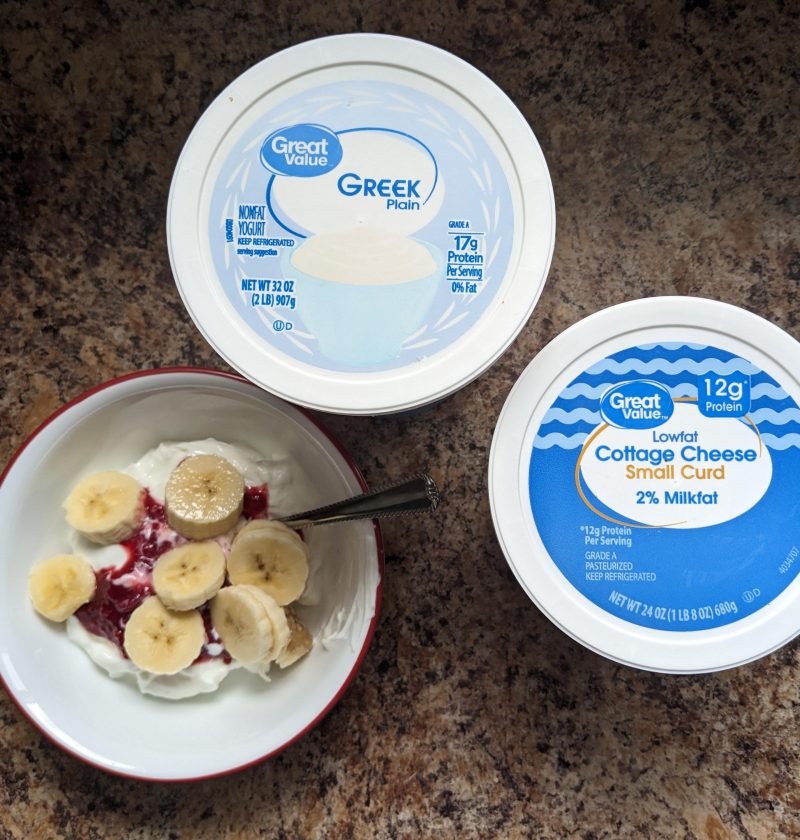
Cottage cheese has been all the rage the last few years. But how healthy is it really? Today we’re doing a quick nutritional comparison between cottage cheese and Greek yogurt to see which one you should add to your protein bagels/waffles/muffins etc.
What does “healthy” mean?
Of course, “healthy” means different things to different people (even among nutrition experts!). Both Greek yogurt and cottage cheese are processed, animal-based products. So they aren’t whole foods, but they do still offer some good nutritional value. (Check out this article from Harvard Health for more about whole vs processed foods.)
There are many factors we could look at to determine the nutritional value of a food. But for simplicity’s sake, we’re focusing on a few parts of the nutrition label. We’ll evaluate the fat, protein, sodium, sugar, and micronutrient content of both Greek yogurt and cottage cheese to see which one gives you more nutritional bang for your buck.
For some general guidelines on what eating healthy looks like, check out my article here.
Low-fat Cottage Cheese
Fat
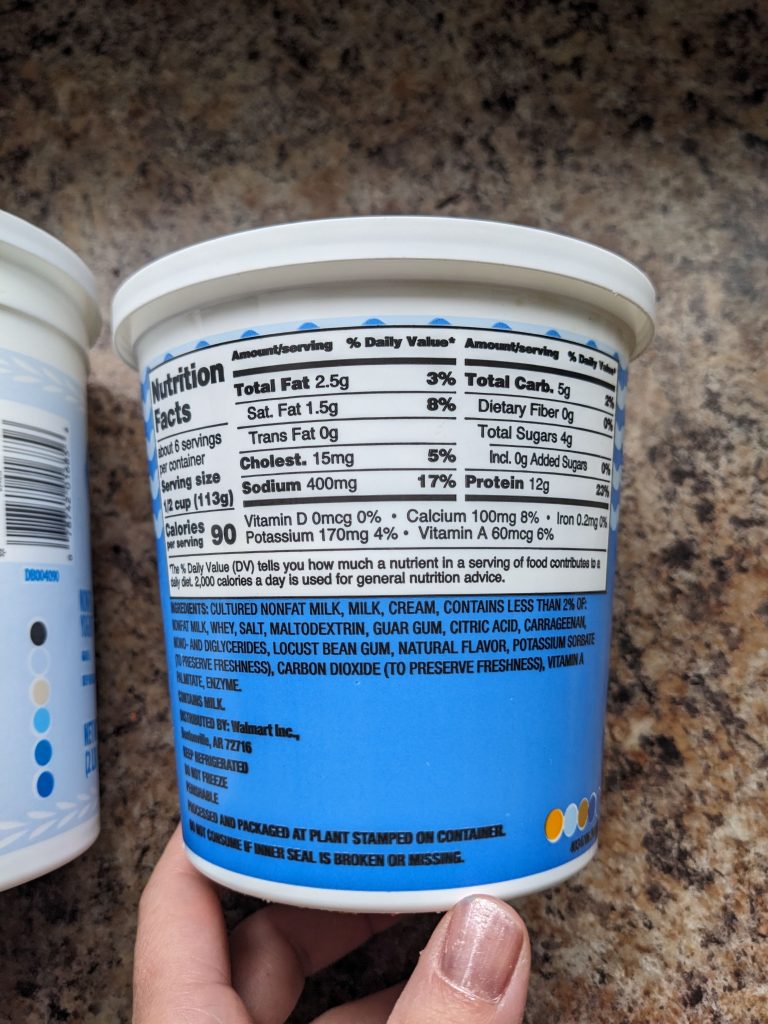
A serving of low-fat cottage cheese has 2.5 grams total fat, only 3% of the total recommended daily value (based on a 2000 calorie diet). Our bodies need some fat, and this is a reasonable amount. It does have 1.5 grams saturated fat, or 8% of the daily value. Once again, this is an acceptable amount. However, MyPlate.gov recommends limiting saturated fats and prioritizing foods with unsaturated fats, as these are better for heart and brain health.
Protein
One serving of cottage cheese has 12 grams of protein. While your protein needs/goals will vary depending on your age, gender, and activity level, this is a good amount of protein (23% of the daily value), especially compared to the fat content. (Many high protein foods are also high in saturated fats.)
Sodium
One of cottage cheese’s big drawbacks is the amount of sodium. One serving contains a whopping 400 mg sodium, or 17% of your daily value. While this can still be part of a balanced diet, it’s important to be mindful of how much total sodium you consume. Too much sodium can be bad for blood pressure and heart health.
Sugar
Cottage cheese has minimal sugar (4 grams naturally, with zero added sugar). Consuming too much added sugar carries a wide range of health risks, including increased risk of diabetes and heart diseases. So eating foods with no added sugar is a great way to reduce your overall sugar intake.
Micronutrients (Vitamins & Minerals)
The small print on the bottom of the label shows a few vitamins and minerals contained in cottage cheese. Even though it is a dairy product, cottage cheese contains 100 mg of Calcium (about 8% of your daily value). While this is a significant amount, it’s much less than you’d get from something like a cup of milk. Cottage cheese also has 60 mcg Vitamin A (6%) and 170 mg Potassium (4%). Overall, cottage cheese isn’t a huge source of vitamins and minerals.
Greek Yogurt
Now that we’ve examined cottage cheese, let’s take a look at Greek yogurt!
Fat
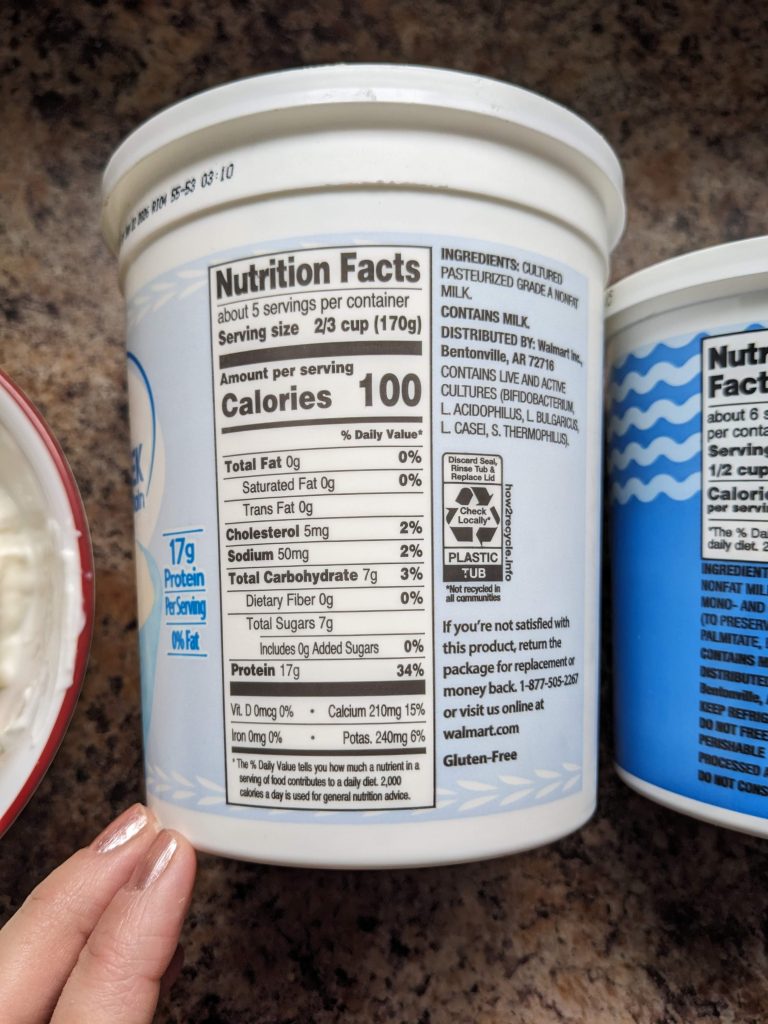
In this case, because we’re looking at fat-free Greek yogurt, there is no fat. This makes it less calorie dense and avoids the saturated fat we saw in cottage cheese. While fat-free doesn’t automatically mean healthy, consuming low-fat or fat-free foods can help you avoid over-consuming saturated fats.
Protein
One serving of Greek yogurt contains a whopping 17 grams of protein (34% of the daily value)! However, these numbers are a little skewed. If you take a look at the serving size, a serving of cottage cheese is 1/2 cup, while a serving of Greek yogurt is 2/3 cup. This means that if you had a 1/2 cup serving of Greek yogurt (to match the cottage cheese), it would be 12.75 grams of protein — only slightly more than the cottage cheese.
Sodium
Unlike cottage cheese, Greek yogurt only has 50 mg of sodium (2% of the daily value). And if you made the serving sizes equal, it would only be 37.5 mg sodium. This is a much more reasonable amount and will help you keep your sodium intake in check.
Sugar
Greek yogurt has slightly more natural sugar at 7 g (or 5.25 grams if you adjust for serving size), but like cottage cheese has zero added sugars. Once again, this is great for limiting the amount of added sugars you consume in a day.
Micronutrients (Vitamins & Minerals)
For micronutrients, Greek yogurt has a little more calcium than cottage cheese. At 210 mg, it offers 15% of the daily value. (However, if you adjust for serving size, this comes out to be 157.5 mg. This is still much more than the 100 mg found in cottage cheese.) The only other micronutrient listed is potassium at 240 mg, or 6%. (Adjusted for serving size, this is 180 mg, only slightly more than cottage cheese.) So Greek yogurt has some benefit with the Calcium, but doesn’t offer much else when it comes to vitamins and minerals.
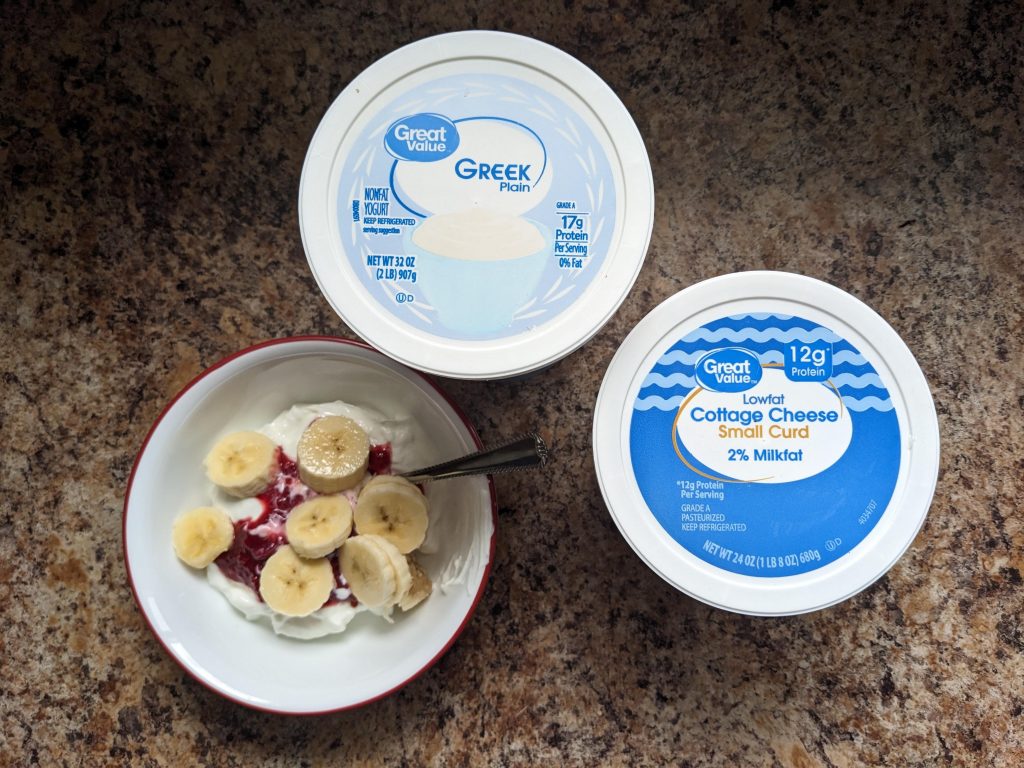
| Nutrients | Cottage Cheese | Greek Yogurt |
| Fat | 2.5 g total / 1.5 g saturated | 0 g |
| Protein | 12 g | 12.75 g |
| Sodium | 400 mg | 37.5 mg |
| Sugar | 4 g / 0 g added | 5.25 g / 0 g added |
| Micronutrients | 100 mg calcium; 170 mg potassium; 60 mcg vitamin A | 157.5 mg calcium; 180 mg potassium |
Is cottage cheese or Greek yogurt healthier?
While both cottage cheese and Greek yogurt can be part of a healthy diet, Greek yogurt offers a little more nutritional value. With less saturated fat, more protein, less sodium, and comparable sugar and micronutrient content, Greek yogurt is the winner!
Looking for a yummy cottage cheese recipe? Try my cottage cheese pancakes with cinnamon apples or my pumpkin cottage cheese pancakes. Or if you want snack ideas with Greek yogurt, check out my list of budget-friendly nutritional snacks!